
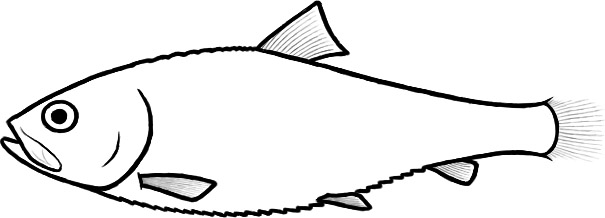
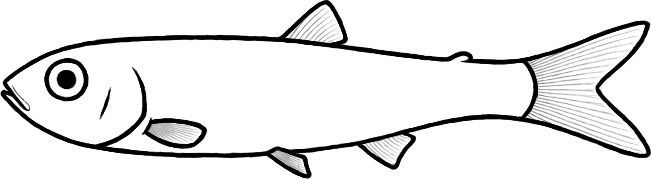
Marcopoloichthys ani, to 4½ cm
Middle Anisian, Yunnan in SW China (Guanling Fm.)
Marine
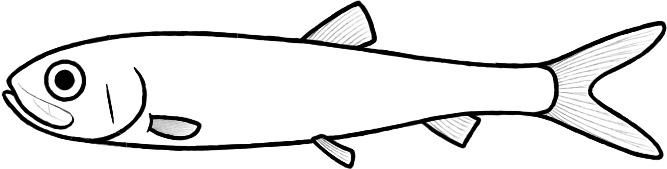
Middle Anisian, Yunnan in SW China (Guanling Fm.)
Marine
Teleosts make up some 95% of all living fish species and around 45% of described vertebrates. The greatest mass of animals is found in the open ocean, and by this measure they come in second only to the crustaceans. But much more of their diversity is found in shallow seas, lakes, and streams all over the world.
The Palaeozoic era is famous for its variety of fossil fish, including the ancestors of land vertebrates, but this giant group is not found at all until the start of the Mesozoic. Here I have tried to give some examples to illustrate their natural history in this era, when they first diversified and began to take over the seas, shaping them at least as much as mammals and birds have the land and sky.
Drawings are based directly off the references given but are my own attempts to interpret them as living fish, for which I have no actual qualifications and may easily have made mistakes. All lengths are given as total lengths, i.e. include the tail fin or an estimate of it.
Josh Grosse – Contact
| Triassic | Jurassic | Cretaceous | Cenozoic | ||||
|---|---|---|---|---|---|---|---|

Teleosts |
Heterocercal teleosts | ||||||

Homocercal teleosts |
Ichthyodectiformes | ||||||
| Crossognathiformes | |||||||
| Osteoglossomorpha | → | ||||||
| Elopomorpha | → | ||||||
| Otomorpha | → | ||||||
| Euteleostomorpha | → | ||||||
The Triassic spans about 50 million years, broken down as follows:
| 252-247 | Induan, Olenekian |
| 247-237 | Anisian, Ladinian |
| 237-227 | Carnian |
| 227-206 | Norian |
| 206-201 | Rhaetian |
Fossil teleosts make their first appearance in this period. Along with Halecomorphi like modern bowfins and Ginglymodi like gars, these are part of a group that share mobile upper jaws, where the maxilla on each side can be rotated forward to cover the sides of the mouth during feeding. Most also have a supporting supramaxilla except when the mouth is small.
Early teleosts are set apart by also having the premaxilla at the front of the upper jaw detached. Sometimes this can be further specialized like in early Marcopoloichthys, small fish with no teeth and only a few scales, which have a long curved premaxilla presumably involved in suction feeding.
In most others the premaxilla has a short ascending process and can be pushed forward. The main Triassic group are the Pholidophoridae, named for their covering of thick ganoid scales. These are small marine fish that probably fed on plankton except for the very largest, Pholidorhynchodon, which were predatory on other kinds.

References for fish:
The Jurassic spans about 60 million years, broken down as follows:
| 201-193 | Hettangian, Sinemurian | |
| 193-184 | Pliensbachian | |
| 184-175 | Toarcian | |
| 175-165 | Aalenian, Bajocian, Bathonian | |
| 165-155 | Callovian, Oxfordian | |
| 155-143 | Kimmeridgian, Tithonian | ← Talbragar, Cerin, Torleite to Mörnsheim Fms. |
During this period some teleosts start appearing in freshwater. The earliest known are the Archaeomaenidae, which have a free premaxilla but no ascending process. They first show up already on opposite ends of Pangaea, with Zaxilepis in Asia and Oreochima of similar size in Antarctica.


Later Aphnelepis and Archaeomaene are found together in Australia. The first have thick scales in front but thinner ones toward the tail, while in the second the whole body has only leptoid scales. These take the form of thin overlapping plates without outer enamel or articulations as in ganoid scales, providing a more flexible and streamlined covering.
A few other families are known from the Late Jurassic of central Africa and possibly Brazil, including Catervariolidae, Ankylophoridae, and Pleuropholidae. I am hoping to find a copy of Saint-Seine (1955, 1962) before I try writing about them.
References for fish:
The Early Jurassic marks a radiation of new teleosts with homocercal tails, where the vertebral column stops instead of extending along the rays into the fin. They also all share leptoid scales so are more flexible and built for propulsion than other relatives. The first known are Proleptolepis from England and some smaller kinds from Chile.
By the Late Jurassic these have split into several major groups, all but the first of which continue through at least the Cretaceous period:
Ichthyodectiformes include early Occithrissops, which probably fed on small particles, and later types like Thrissops that were predators of smaller fish. The latter are also one of a few fish where fossils have preserved a colour pattern, with small dark marks on the scales.


Crossognathiformes are first represented by Varasichthys and relatives from Chile and Cuba. Then Luisiella and the orthogonikleithrids Cavenderichthys, both placed somewhere between surviving lineages (crown teleosts), are the oldest examples of homocercal teleosts found in freshwater habitats.


Otherwise these groups are mostly known from the shallow seas around Europe. Here both ascalaboids like Tharsis and smaller orthogonikleithrids are common. There are also several Elopomorpha like Anaethalion as well as some leptocephalus larvae characteristic of that group.


Otomorpha had also started to diversify. In Europe they are only represented by relatively late Tischlingerichthys. After this though there are also southern Ancashichthys and Aijaichthys, kinds with dorsal and ventral scutes typical of the order Ellimmichthyiformes.

This leaves the Osteoglossomorpha and euteleosts but so far they are not known for certain before the Cretaceous, with only an incomplete Paralycoptera possibly from the Tithonian of Hong Kong.
References for fish:
References for distribution, dates, and classification:
The Cretaceous spans about 75 million years, broken down as follows:
| Early Cretaceous | ||
| 143-133 | Berriasian, Valanginian | |
| 133-121 | Hauterivian, Barremian | ← La Pedrera de Meià, Morro do Chaves Fm. |
| 121-113 | Aptian | ← Romualdo Fm. (except top) |
| 113-100 | Albian | |
| Late Cretaceous | ||
| 100-94 | Cenomanian | ← Sannine Fm. |
| 94-84 | Turonian, Coniacian, Santonian | |
| 84-72 | Campanian | |
| 72-66 | Maastrichtian | |
References for dates:
Elopomorpha are united by having leptocephalus larvae, which are ribbon-shaped and decrease in length as they change into juveniles. This stage is always marine though some also move into brackish or freshwater as adults. There are four orders:
The earliest Cretaceous representatives are Baugeichthys from the Albuliformes and Ichthyemidion from the Elopiformes, which are set apart by long jaws with a broad band of needle-like teeth. The latter kind is already about as close to modern tarpons and tenpounders as they are to each other.
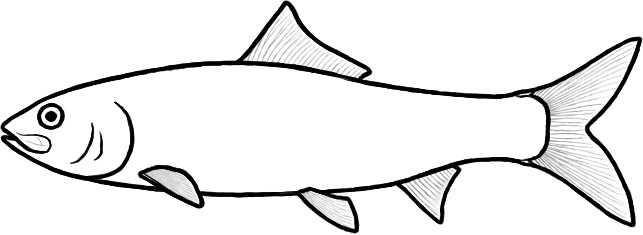
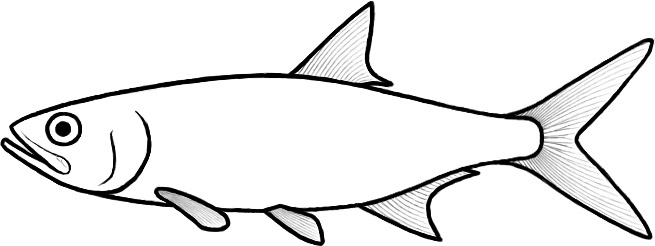
Like osteoglossomorphs, these two orders typically have palates with parasphenoid teeth, which have been lost in most other Cretaceous groups. In Elopiformes they remain small but in many Albuliformes they have instead developed into plates of large round teeth suitable for crushing shelled prey, first known from Brannerion.
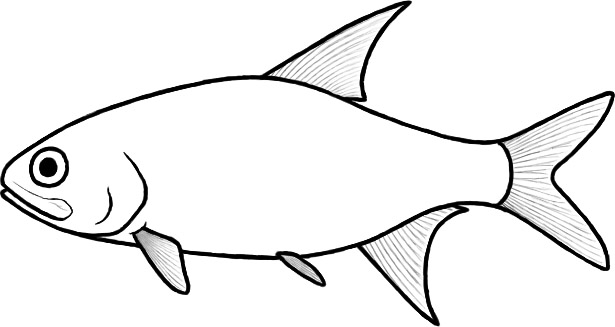
True eels appear at the start of the Late Cretaceous with Luenchelys and several other Lebanese genera. These already have long bodies and most have lost pelvic fins. The premaxilla has also lost its mobility and in Libanechelys is partly fused to other bones, along with the tail and anal fins being joined together.
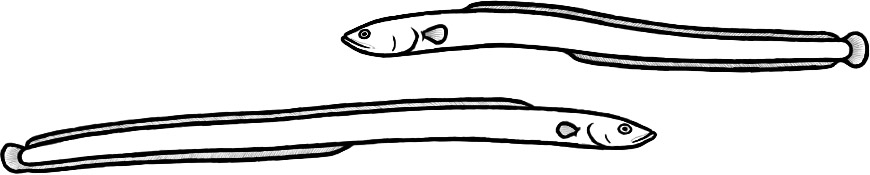
Later eels have the tail fin joined to both the dorsal and anal fins in a continuous ribbon around the end. In modern kinds the pectoral girdle is also separate from the skull, but this does not appear known before the Cenozoic.
References for fish:
Otomorpha include several orders that presumably diverged during the Late Jurassic and Early Cretaceous as the continents were separating. Unfortunately the largely freshwater Otophysi have very few fossils then, though the timing is partly reflected in their later distribution.
Most kinds have swim bladders with different specialized connections, especially ones carrying sound to the inner ears, recognizable in fossils from associated skeletal features. However swim bladders have also been lost in the deep-sea Alepocephaliformes and a few others.
Near the start of the Cretaceous otomorphs are mostly known from freshwater and brackish lakes in Brazil and Spain. Some of these probably tolerated a range of salinity though, and they are still closely related to marine kinds, which become better represented afterward.
References for fish and classification:
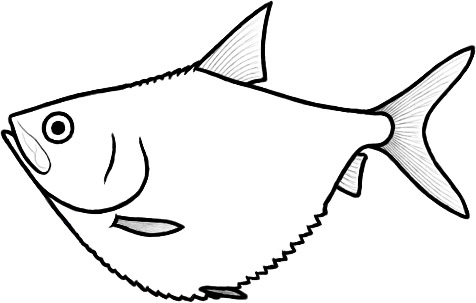
Clupei have swim bladders in direct contact with the inner ears, extending through the exoccipital bones at the back of the skull into enlarged chambers called bullae. Most kinds also have a line of ventral and sometimes dorsal scutes, as seen in the Jurassic ancashichthyids.
Clupeiformes are first represented by Pseudoellimma and Cynoclupea, followed by the more complete cynoclupeids Santanaclupea. These latter two were predators of smaller fish. They are thought to be related to the Denticipitidae found in Cenozoic Africa, which have one living species (denticle herrings).
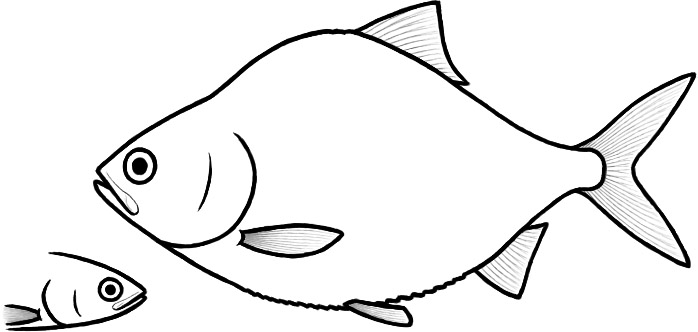
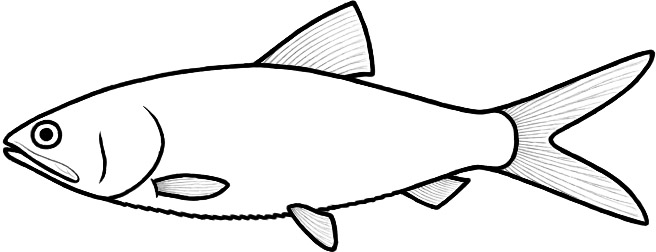
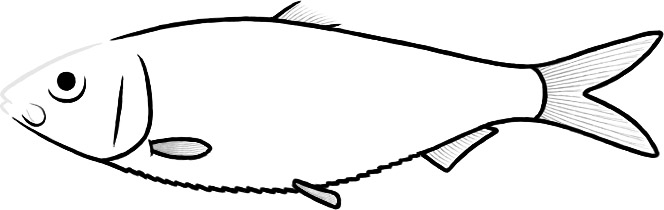
Pseudoellimma on the other hand have toothless jaws with signs of reduced adductor muscles, which are typical of filter feeders. They are closely related to the Clupeoidei, first known from small Nolfia species found across the new South Atlantic and including nearly all others from the Late Cretaceous on.
References for fish:
Gonorynchiformes usually have swim bladders with a separate anterior chamber but no connection to the ears. Instead they connect through modified pleural ribs and special intermuscular bones to the back of the skull and pectoral arch, possibly as a support for it. The jaws are small with no teeth.
This order is first known from freshwater Chanidae like Rubiesichthys. That particular kind is also dimorphic with half the adults developing deeper bodies, presumably the females. They probably fed on minute food particles captured while swimming.
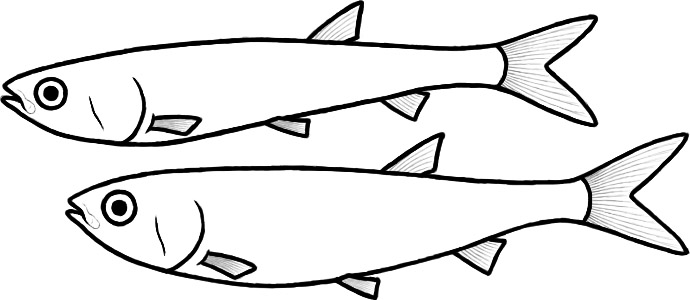
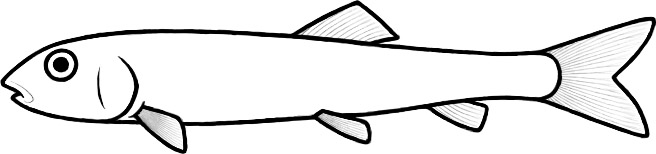
During the Late Cretaceous most fossils are from marine Gonorhynchidae, e.g. Ramallichthys, all long fish with conical teeth on palatal and branchial plates. Both these families are still alive today in the Indo-Pacific, while Kneriidae (shellears) are found in Africa but not known before the Cenozoic.
References for fish and characters:
References for distribution:
Otophysi have swim bladders with an anterior chamber linked to the inner ears by small bones called Weberian ossicles, forming distinctive sound-transmitting structures on either side of the first few vertebrae. The oldest fish where these have been confirmed are Sooinichthys from the Tethys Ocean.
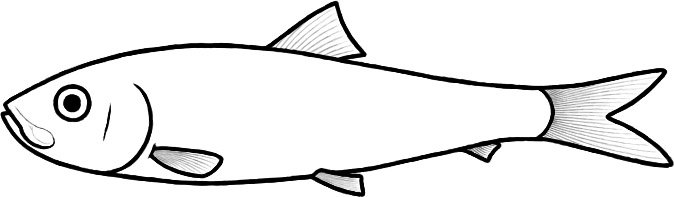
The first complete representative from freshwater is Acronichthys, found in North America but placed closest to the African Cithariniformes. Others groups are also known during the last part of the Cretaceous but only from fragments, recognized based on features of the different orders.
References for fish:
Euteleostomorpha or euteleosts make up the largest group of teleosts, including over half the living species. These are extremely variable and break down into a few different lineages, which would have all diverged during the Cretaceous:
Adipose fins are common among the non-acanthomorphs, while acanthomorphs usually have fins with anterior spines in addition to the soft rays. Many share features like swim bladders that detach from the gut and bones without osteocytes, but some of the first few orders are exceptions.
An unusual skeletal feature in most euteleosts is an extension of one of the dorsal tail bones (a stegural), though this is also found in a few other fish like orthogonikleithrids. After them it is first tentatively reported in Scombroclupeoides, given uncertain placement here.
A few other early types have been described as potential Argentiniformes or Salmoniformes. I am hoping to find copies of Taverne (1975, 1982) before I try saying anything about them. Otherwise Protacanthopterygii are only represented by jaw fragments until the Cenozoic.
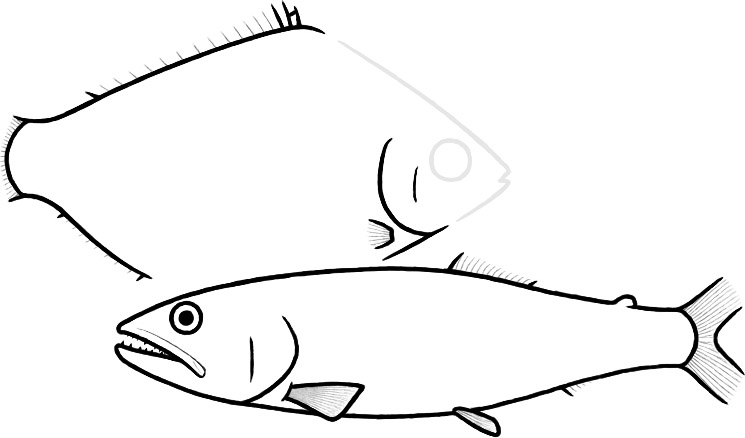
Meanwhile the first examples of more derived euteleosts are predatory Atolvorator from the Aulopiformes and Gondwanacanthus from the acanthomorphs. Both these groups next appear in the mid Cretaceous and become very common from then on.
References for fish:
References for classification:
Note – Near & Thacker (2024) say Tchernovichthys are the first pan-euteleosts and Nybelinoides are pan-Stomiati. Unfortunately as far as I can tell these are only guesses or mistakes from Guinot & Cavin (2016). That paper also explicitly treats unplaced genera as if they made their own separate groups, which I trust works for their analysis but is badly misleading to present as current understanding.